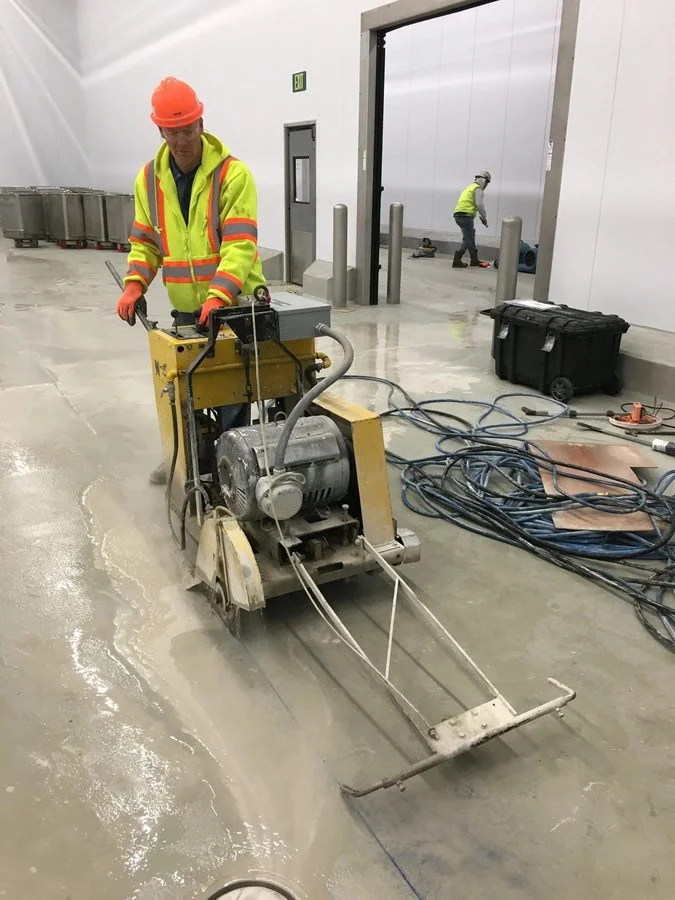
What Is Flat Sawing?
Flat sawing is the most common type of concrete cutting. It is used to cut control joints in concrete slabs, to create openings in concrete floors, and to saw concrete for utility installations.
Control Joints
Control joints are necessary in a concrete slab to control cracking. We are experienced in determining when and where the joints should be cut to ensure the integrity of the slab. Without joints, concrete will crack randomly as it cures and shrinks. Our flat saws cut precise, clean joints that guide cracking along straight lines.
Street / Roadway Sawing
Road construction projects, patch repairs, and lane replacement projects can be handled with ease with our powerful 65 hp diesel flat saw. We can cut up to 16" deep with precision making your job easier.
Indoor Slab Sawing
Plumbing trenches to slab removal in an industrial plant — our arsenal of equipment has your concrete sawing needs covered. Our equipment is powered by gas, electric, hydraulic, or propane and can cut up to 16" deep. We can even do your removal. We will make your construction jobs easier.
Utility Installations
Flat sawing is essential for trenching concrete to install utilities such as water, sewer, gas, and electrical lines. We can cut trenches of any length and depth to accommodate your utility needs.
Removal Services
After sawing, we can remove the concrete sections and haul them away, leaving a clean jobsite ready for the next phase of construction.
Dust Control
For flat sawing, we use wet-cutting with water suppression on outdoor jobs to keep silica dust down. Indoor slab work uses our HEPA-filtered vacuum system — either wet or dry depending on the environment. We stay fully compliant with OSHA silica regulations on every project.
Before
After
Flat Sawing — Frequently Asked Questions
Our largest flat saw can cut up to 16 inches deep in a single pass. For most control joint applications, 3-6 inches is typical. We have multiple saw sizes to match your exact depth requirement.
As a general rule, control joints should be spaced at 24-30 times the slab thickness. For a 6-inch slab, that means joints every 12-15 feet. We follow industry best practices and your project specifications.
Yes. Our diamond blades are designed to cut through rebar-reinforced concrete. The blades contain metal-bonded diamond segments that handle both concrete and steel reinforcement.
Control joints should typically be cut within 4-12 hours after pouring, depending on concrete mix and ambient conditions. We coordinate with your pour schedule to ensure timely joint cutting.